
Workflow Acceleration Sprint

Free Guide: Workflow Acceleration Sprints
Learn how to make work easier, go faster, or scale what you have.

What You Need to Know: Pre-Work
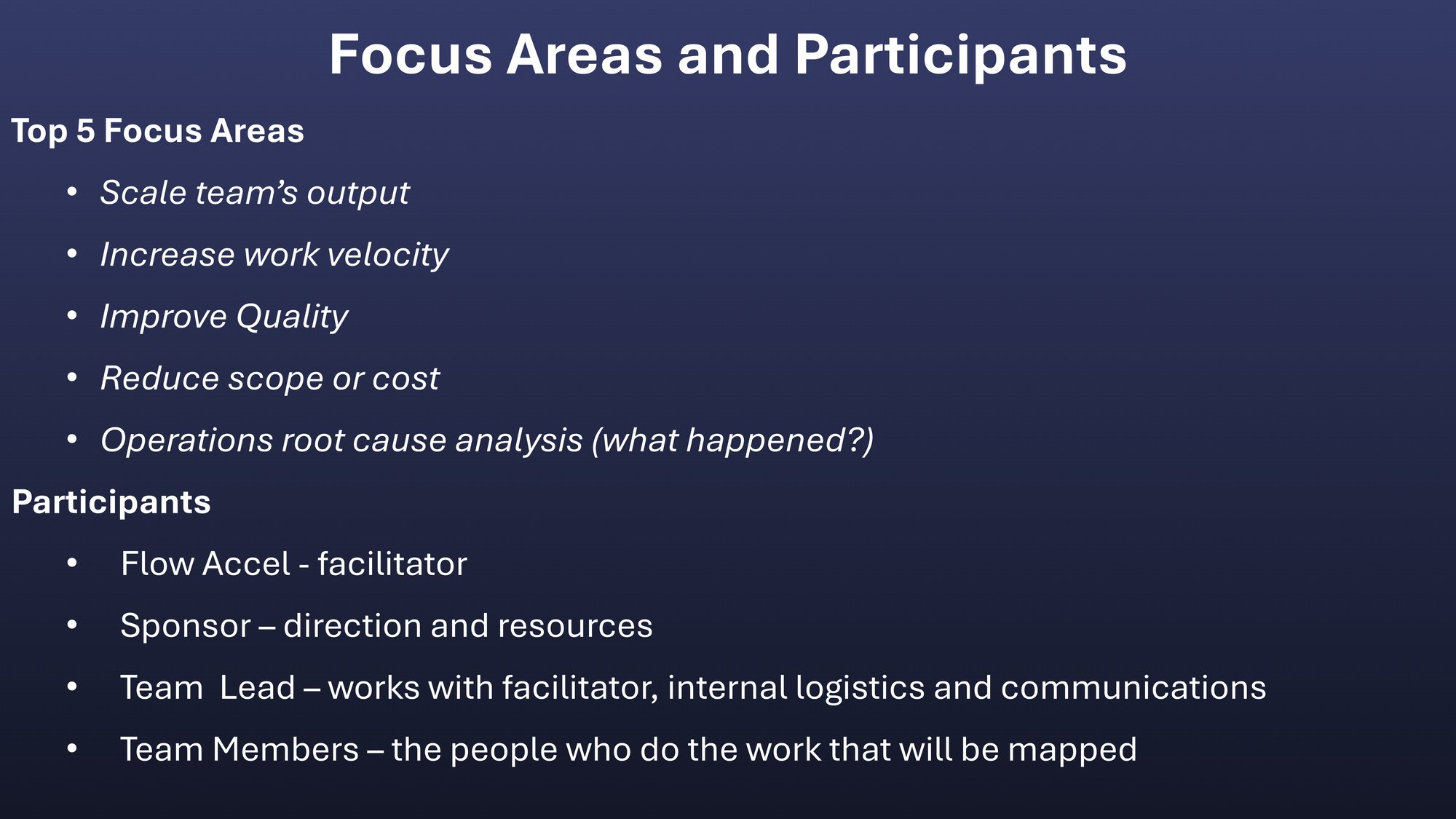
If the initial workflow assessment shows that your problem can be addressed with a workflow acceleration sprint, we'll dig into the specifics to ensure the event is a success. This work will usually start 2 to 3 weeks ahead of the event. This will depend on the problem at hand, the scope, and how fast the team wants to go. We need active support from the sponsor, involved leaders, and a single point of contact needs to be identified as the team lead. We will work with this individual throughout the entire process to ensure that everyone is clear on what we are doing and why, and to keep everyone up to date as the work progresses. The team lead's first job is to identify a sponsor for the event. This may already be evident from the initial engagement.
Problem Statement and Expected Outcome
-
We draft an initial problem statement with key stakeholders up front
-
The problem statement and expected outcome provide focus and control the scope
-
The sprint needs to solve the problem and achieve the expected outcome
-
Discoveries beyond the scope of the problem and outcome will be captured, but not addressed
Logistics
-
Flow Accel will determine the sprint timeline and schedule in collaboration with the team lead
-
Typical event lasts 2 full days: the team lead and team members attend all activities
-
A time-based schedule for each activity will be published prior to the event
-
Some short breaks during the sprint, and the team can use this time to sync with people outside the sprint if needed

What You Need to Know: Kick Off
During the kick-off we bring in the entire working team. The team lead will speak to the direction from leadership and help the team understand why they are being asked to support this effort. Flow Accel will speak about what we do and how the workflow acceleration sprint will work. Once the team is level-set, we will move on to refine and finalize the problem statement and expected outcome. Participants will help us dial in the sprint's focus and specifics, and we want their buy-in. Sometimes adjustments will be identified during this meeting, and we will engage stakeholders with that information to ensure we are fully prepared for the 2-day event.
Finalize the problem statement
-
Flow Accel will drive the finalization of the problem statement
-
It needs to be clear, specific, and aligned to the purpose of the sprint
-
The team lead will represent leadership and guide the final draft of the problem statement
Alignment on expected outcome
-
Flow Accel will drive the finalization of the expected outcome, which will set clear boundaries for the sprint and focus for the future-state workflow design
-
The team lead will represent leadership and guide the final draft of the expected outcome
Determine the start and end points of the process
-
With the problem statement and expected outcome in place, we can determine the endpoints of the workflow map
-
We identify the first activity and last activity that surround the problem and will deliver the desired outcome
Finalize team and logistics
-
Flow Accel will drive the finalization of the team membership
-
The team lead will assist Flow Accel in getting commitment from the sponsor, team leaders, and team members
What You Need to Know: Current State
This is where the rubber hits the road. It is critical for the team to develop a deep shared understanding of how work is done today. This will build the foundation for addressing the problem and designing a new workflow. Teams usually know their work extremely well, but usually do not know the details of other teams' work. This knowledge sharing is key to accelerating and scaling work.
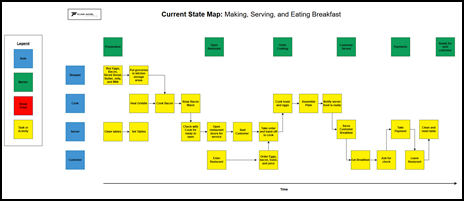
Develop a workflow map
-
The facilitator will build out a template map to get started and may seed it with activities for a jump start
-
The team will map out the current work process, guided by the facilitator
-
Each role involved will map out its part of the activities performed
Deep shared understanding of the current state
-
Developing the map is a knowledge-creating activity
-
Team members will better understand their own work and other teams' work
-
Remembering what actually happened can be challenging; we have had to dig through old emails to figure it out
-
Moving forward for the best results, this process should be used as soon as the problem or challenge arises
What You Need to Know: Analysis
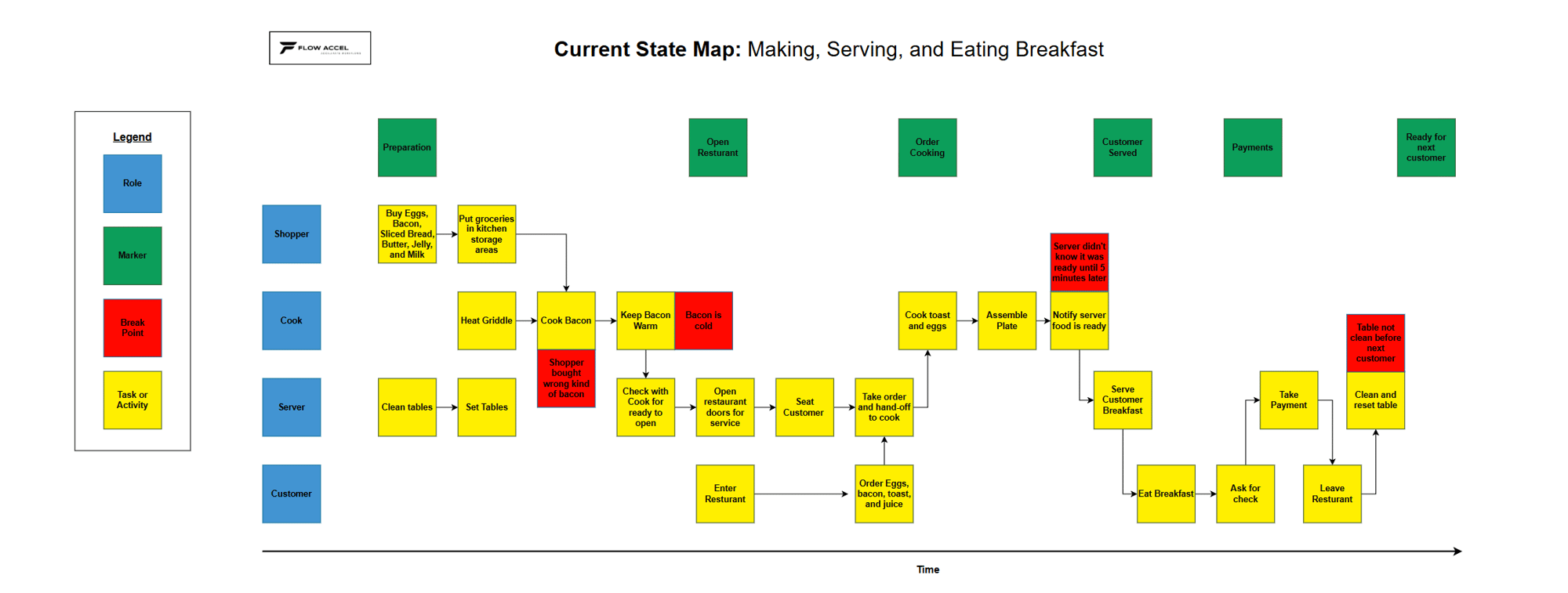
Analysis is identifying how the workflow broke down or limited the team's ability to meet some desired outcome. We call these "Breaking Points". It is important for the teams to be brutally honest about what really happened. If the culture punishes messengers who deliver bad news, this activity will be a challenge. We need to help everybody see problems as opportunities to get better. It is usually the process that lets people down, not the people who let the organization down. We all have good people, but we don't all have good work processes. Over time, once the team gets the hang of this process, leaders will have trouble keeping up with all the problems that teams identify.
Identify workflow breaking points
-
After a shared and deep understanding of the current workflow is accomplished, it is time to look for breaking points
-
Breaking points are places where the workflow broke down (also referred to as a defect) or where things went wrong
-
The impact of breaking points will vary
-
Breaking point examples: delays, rework, recalling painful work moments, can't do what is supposed to be done, quality or data problems
-
The highest offending breaking point category is hand-offs between teams
-
-
Flow Accel will coach the teams on how to discover breaking points to ensure they are all documented
- The team lead should probe or draw out issues that the team is not addressing
Impact, priority, and owners
-
Facilitator drives impact and priority assessments, as well as ownership assignment
-
The team will assign High, Medium, and Low impact to each breaking point
-
The high-priority breaking points are prioritized, and maybe some medium-priority
-
For each breaking point that was prioritized, there will be an impact assessment and an owner assigned
- Owners will be responsible to help drive the improvements and provide updates back to the sprint team
Future State
What You Need to Know: Future State
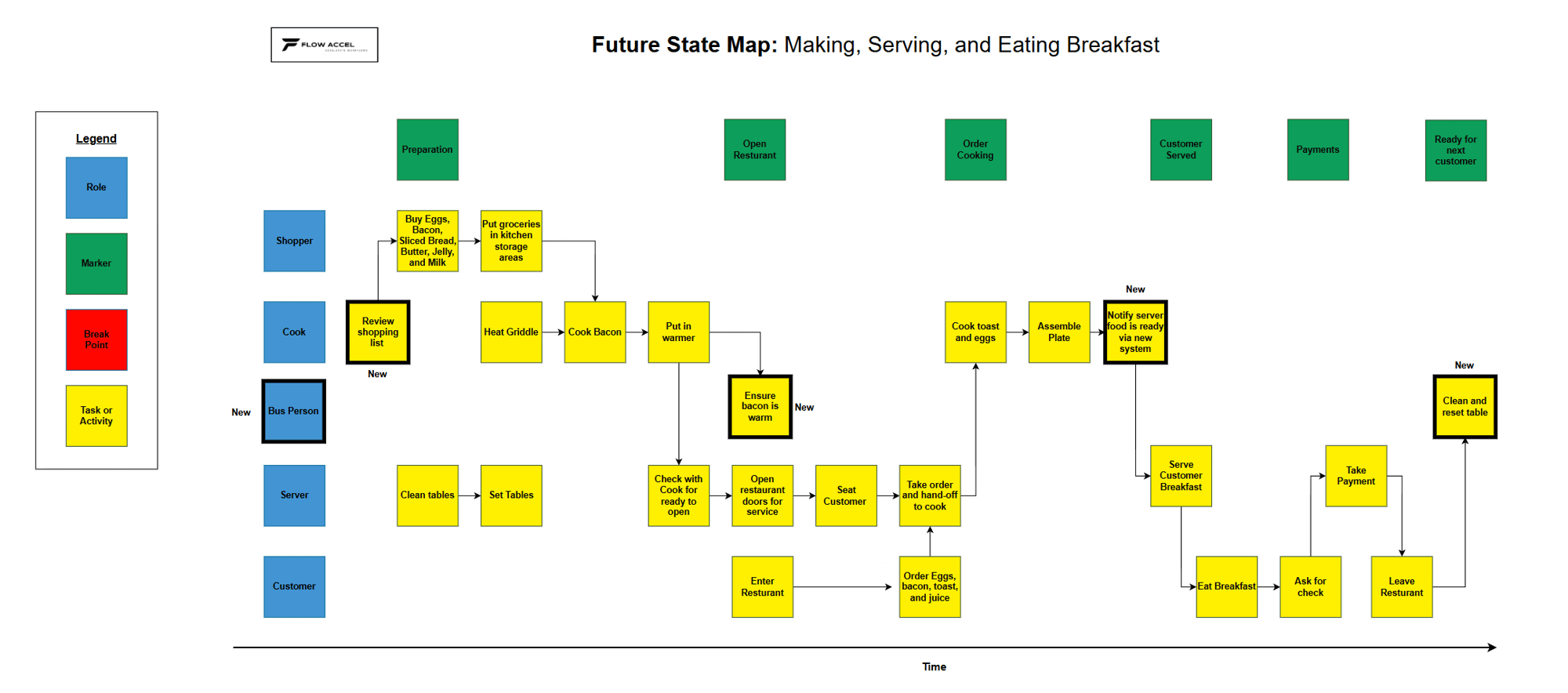
The future state design is focused on solving the problem and achieving the expected outcome. The future state workflow design is modified to eliminate the breaking points the team identified. The team should not be encumbered by the current design and should design the workflow needed for today and tomorrow. The team develops high-level action plans to solve the problem and achieve the expected outcome.
Eliminate breaking points
-
Breaking points are eliminated by modifying the current state workflow design
- Teams can add or modify activities, add roles, switch activities between roles, or move activities to a different workflow altogether
Address the problem
-
During the future state workflow design, the team needs to focus on addressing the original problem statement
- This was the reason the workflow acceleration sprint was kicked off to begin with
Achieve the expected outcome
-
During the future state workflow design, the team needs to focus on achieving the expected outcome defined up front
- The future state design is not complete until it achieves the expected outcome
Action plans
-
Develop a high-level plan: start with the top priorities and focus on the next 30 days
-
The owner identifies what needs to be done, who they need, and proposes a high-level schedule
-
Repeat for the top priorities, stop when plans start extending out beyond 30 days, or the top priorities are all addressed
-
Summarize what is left to do after the first 30 days
- Flow walkers need to be armed with this information for the Flow Walk

What You Need to Know: Flow Walk Prep
Flow Walk: problem statement, expected outcome, current state, future state, plans, and summary
A Flow Walk is the team sharing with leaders and stakeholders what they accomplished during the two days by reviewing the problem statement and expected outcome. Sharing what they discovered in the current state analysis. Then, articulating their future state plans while highlighting the changes that they propose making along with their impact
Identify flow walkers
-
Identify who will cover the problem statement and expected outcome
-
Identify who will walk the flow for the current state map: describe where the work starts, then what happens after, highlight discoveries, breaking points, and general challenges.
-
Identify who will walk the future state map: describe the new design, show how it addresses the challenges discovered, and how it is aligned to the problem and expected outcome.
- Identify who will cover the summary
Practice
-
Once the Flow Walkers are identified, each should practice their part
-
Think about the audience and what they would be interested in hearing
-
Problem statement and expected outcome help them understand why they are there and what you are doing
-
This will help the audience learn more about the flow and understand why the team designed the future state the way it is
-
Hit the high points, not every sticky
-
-
For the current state flow walk it is very important to share the story of discovery, the breaking points, and highlight their impact
-
Walking future state is about what that team proposes to change to fix breaking points, solve the problem, and achieve the outcome
-
- Summary is a closing statement, hitting key points, impact, changes, and help needed
-
- It is very important for the team to ask for help during this portion if they need money, resources, or anything to help them get to the future state they described
Flow Walk

What You Need to Know: Flow Walk
This is the highlight of the event. The team gets to showcase their work. This should be brief and to the point and should only take 15 to 30 minutes. Flow Walks are a great way to share a tremendous amount of information in a very short period of time. The team is sharing knowledge about what they learned. They are letting the team know what they will do next. A very important aspect of the Flow Walk is to get leadership and stakeholder alignment, buy-in, and support.
Level Set: Problem and Outcome
-
Quick and to the point: Clarify the problem and the outcome or outcomes that the team is seeking
Share discoveries
- It is critical to share what was discovered. Discoveries help everyone with knowledge and help create alignment among teams and leaders.
Tell a story
- The problem, outcome, current state, future state, and summary should be told like a story.
Get buy-in
- Many know about the problem but they won't know what the team knows. Share what you know and get buy-in from all stakeholders.
Make it happen
- Run the improvement like a program, meet as needed to get the outcomes the team is looking for, keep leaders and stakeholders up to date
- Share what was learned with other teams and train anyone who needs to know
- Run the new process like an experiment, test your hypothesis to see if the solution works; if not, take what you learned and adjust, then test it again
- Add monitors or metrics as needed
- Watch it to make sure it sticks
- Move on to the next problem
Follow - Up
What You Need to Know: Follow-up
- A few weeks after the improvement Flow Accel will check-in with the team to have them share their progress and see if any help is needed
- Flow Accel is committed to helping your team get the results you are looking for