

All parents hope their children will have a better world than the one they have. From a business, job, and work-life balance perspective, things seem to be getting worse, not better. Join me today in advocating for a new generation of leaders who better balance the needs of all stakeholders: shareholders, society, and employees. There is a world where we can have successful businesses, vibrant societies, and an effective work-life balance for all. We just need to step back occasionally, take a deep breath, and refocus on what is important in life.
Corporate Obsession with Shareholder Value is Hurting People and Our Planet
The Great Stock Market Crash of 1929 and the Great Depression in the 1930s caused people's trust in business leaders, especially corporations, to reach its lowest point in our history. Congress passed laws, enacted regulations to protect society, and established institutions like the Securities and Exchange Commission. Over the years, additional protections have been put in place to safeguard workers because protecting people and benefiting society costs businesses money. There must be a forcing function to strike the right balance, because business in general just won't do it on its own. There is an inherent conflict between business profits and social welfare. It is difficult to strike the right balance, and things are out of balance today.
After WWII, public sentiment toward corporations began to shift, as they had helped America and its allies win the war. Over time, they continued to gain power and became less influenced by Congress or public opinion. In recent years, Congress has been silent when it comes to standing up for people and society. During this period, an invention sparked a transformation in the relationship between business and people. The invention of shareholder value was the spark that led to the devaluation of social welfare and employees.
Shareholder value was an invention by financial economists that gained traction in the 1970s and 1980s, 178 years after the New York Stock Exchange was founded. They were looking for a way to help corporations that were struggling as global competition dramatically increased after WWII, as countries around the world began rebuilding. Later, they regretted it as they saw what companies were doing with their invention. Corporate and Wall Street leaders benefited most from this change in values. Social and employee welfare were adversely affected.
In 1999, at the Business Round Table, a membership-funded, nonprofit trade association and lobbying group composed of more than 200 CEOs decided that shareholder value was the only priority for a corporation. Focusing on social welfare or employee care was not a priority. This decision was codified in a charter-like document at the time. Many people likely didn't realize it was a deliberate choice by business leaders; I didn't. It seemed like a continuation of the growing power of business, financial institutions, and billionaires. During this period, the influence of shareholder value peaked. Over time, this sole focus has waned, but the allure remains as leaders become more transactional and less connected to employees than at any point in our history.
The technology age began to separate leaders from business operations and their people as they focused more on visions and transformations. At the same time, corporations have grown into large organizations with many hierarchical levels, further distancing leaders from their people. Accounting and financial analysis in corporations have shifted away from operations toward abstract financial targets created by financial reporting requirements. This has led to cutting costs in the wrong ways and in the wrong places, deprioritizing quality and creating a shorter-term focus aligned more with quarterly financials. This shift in focus, along with the emphasis on shareholder value, has further eroded corporate contributions to social welfare. Huge corporate layoffs get cheers from shareholders and Wall Street as stock prices rise today. Ever since Franklin Delano Roosevelt's New Deal and the end of WWII, it has been easy to see how corporations have been cutting the cord with society and employees. Today, it seems that all corporations care about is shareholders and profits. When you work in one, you can feel the priorities. The only measure of success today seems to be quarterly financials. The economic and financial engine of the United States at the moment seems untouchable.
Society’s trust in business leaders to do the right thing for people has been declining since its post-World War II peak. Unfortunately, society and employees have become less influential at the same time. Pensions have disappeared, and now people fund most of their retirement if they are able to save anything. Employees now get little help with their career development, and for many, it's more like sink or swim. Employees are on their own, and if they can't learn fast enough or have a manager who won't help them grow, performance management will take care of their careers for them. Employees today are seen as a means to an end, revenue. The days of loyalty to your employer are over. It's survival of the fittest.
Stock options, shareholder value, and leaders at the top of the organizational hierarchy have put the value of money far above the value of people. That focus has contributed to polluting our drinking water, global warming, and other challenges for future generations. The lust for power and greed is alive and well in corporate America today, as many corporations pass the 3-trillion-dollar valuation mark. Leaders should focus on shareholder value; investors deserve a return, but so do society and the people who work for them. What we need is more balance in our world so that more people struggle less in life.
Corporate Accountability is a Problem
Corporations today lack accountability to people and society; they are too focused on serving shareholders and self-interest, and our economic world is out of balance. Many of us own shares in companies but have no illusion that we can influence their decision-making. A typical shareholder owns only an extremely small percentage of a company's stock; this corresponds to virtually no power to influence. Congress is silent today compared to the 1930s and does very little to help society and people rein in corporate power and greed. The corporate world and its lobbyists are in control today, not Congress, and therefore not society or people. Corporations' increased focus on shareholder value over the last few decades has been hurting people and our planet. Many have seen their wealth grow, but at what cost to society, employees, and our planet?
Small businesses are different; they are accountable to the people they see face-to-face every day in their communities, whether at their kids' sporting events or out and about. I remember starting one of my businesses back in the day. I was selling Mutual Funds through Jorgensen Financial Services LLC. I was selling investments to my neighbors, the local community, and my grandmother. Having your grandmother as a customer is the ultimate accountability for a business owner. Not only was my reputation at stake, subject to real, tangible public and family opinion, but I also didn't want to lose access to her homemade egg noodles and cherry pies, yum! Maybe that is what we need: more grandmothers in boardrooms and in top corporate leadership positions. I think the world would be a better place if that were possible. Grandmothers tend to bring out the best in us.
With Congress absent in helping us find a better balance between business profitability and social benefit, as they did after the Great Stock Market Crash and the Depression, the only power we have today is our wallets. As you spend money, think about whom you are giving it to and what they will do with it. As a corporate leader, think about what a small business owner would do, act as if your customer is your neighbor, and consider what your grandmother would say about how you treat your community and employees.
COVID Was Revealing
In times of stress, people's true colors sometimes show. This was true for corporate America during and after COVID. In 2019, at the Corporate Round Table, CEOs agreed to take a more balanced approach beyond shareholders, but when COVID hit, that commitment was abandoned. From 2020 to 2022, corporations spent about $1.5 trillion on share buybacks; the addiction to personal gain is as strong as ever. During the same period, they spent about $67 billion on charitable giving, or about 4.4% of what they spent on boosting shareholder value. At the same time, 32% of workers worldwide, or 1 billion people, reported losing their jobs. Furthermore, businesses today contribute only about 7% of charitable giving in our country. It's not that they haven't done any good; it's just that things are out of balance. Business should be about more than profits and share price.
The consequences of today's untethered financial and economic forces are that 48% of the workforce is experiencing burnout, and 44% of the US full-time workforce is not earning a living wage. Corporate profits, on the other hand, have surged 700% in the last 25 years. Amazingly, 300% of that gain occurred in the last 4 years after the COVID pandemic. For some reason, pandemics are good for business; that should make us take a step back. Below is a graph of corporate profits vs. wages. You can see a spike in profits aligning with the timing of the pandemic.
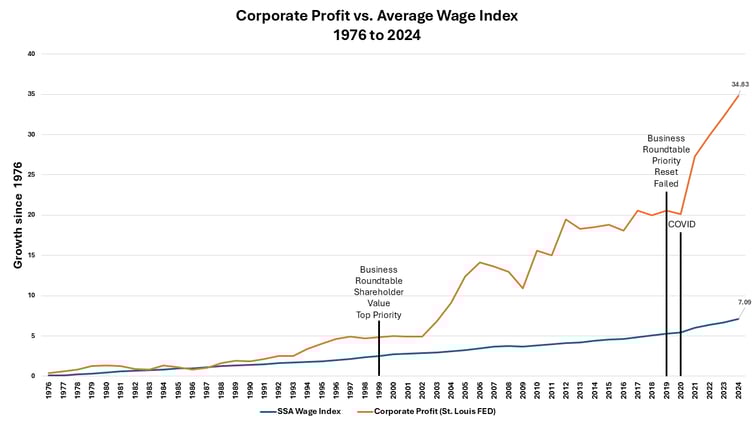
The plot below is from The Wall Street Journal on corporate profits vs. labor compensation. From the article, "Winners and Losers: Since the end of 2019, just before the pandemic, workers have basically just kept up. After inflation, average hourly wages are up 3%. For workers in aggregate, total compensation is up 8%. Meanwhile, profits have climbed 43%. "
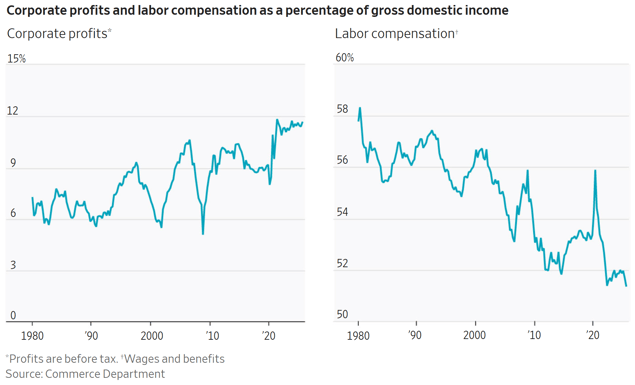
One would think that higher profits would lead to higher compensation, but corporate profits doubled, as shown in the graph on the left above, while wages dropped, as shown in the graph on the right above.
Below is a plot of the S&P 500 over that same time period.
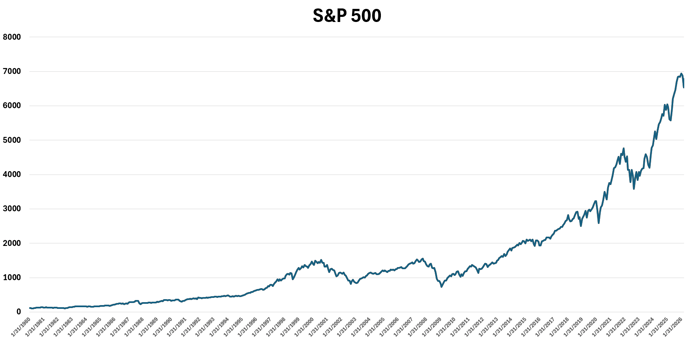
It is obvious where the priorities lie for corporate America today.
Fortunately, many companies do not follow the same script; instead, they take a more balanced approach to running a business. We have all heard and seen many heartwarming stories in the news about restaurants and small businesses helping their people during COVID. Some corporations help their communities, prioritize social welfare, and truly care about their employees. Here are a few examples. It was fun reading about what these companies have done to make the world a better place.
In Good Company: 50 U.S. Businesses That Stood Out During the Pandemic - Newsweek
- During COVID, Airbnb, the lodging firm, helped find accommodation for first responders, health care, and relief workers. Its hosts offered up more than 200,000 different housing units and frontline workers booked more than 100,000 nights in free or subsidized accommodations.
How Companies are Giving Back to their Communities in 2025 - VentureFizz
- With so many folks experiencing food insecurity and shrinking or unavailable SNAP benefits, Wistia launched a hybrid food drive initiative to help the community where their HQ is located.
Merck & Co. developed ivermectin, a drug that treats river blindness. In 1987, Merck & Co. decided to donate it free of charge, indefinitely, to affected countries. Tens of millions were treated annually. The disease was eliminated or controlled in large parts of Africa and Latin America. In 2025, Merck commemorated 5 billion Mectizan® (ivermectin) doses donated over 38 years.
There are many more stories like these that show what we are capable of. It is a matter of mission, values, goals, and priorities. Corporate accountability changes over time; hopefully, the next swing will be back toward society and people. Ultimately, the impact on social welfare comes from top leaders and boardrooms. Today, they are choosing money over people, with no accountability to society or employees. Ideally, employees always have the option to leave and work elsewhere if they are not happy. But that isn't always as cut and dried as it seems. Many are trapped in their jobs today because of personal challenges. The good news is we have the power to choose differently, and leaders can do great things with a more balanced approach to running businesses. If the current leadership isn't able, then let's replace them with leaders who will.
Ultimately, the impact on social welfare comes from top leaders and boardrooms. Today, they are choosing money over people, with no accountability to society or employees. Ideally, employees always have the option to leave and work elsewhere if they are unhappy. But that isn't always as cut-and-dried as it seems. Many are trapped in their jobs today because of personal challenges. The good news is that we have the power to choose differently, and leaders can do great things with a more balanced approach to running businesses. If the current leadership isn't able, then let's replace them with leaders who will.
Leaders Need to Seek Balance and We All Should Enjoy the Journey
Corporations and businesses have every right to make a profit, and they should pursue it with passion. It's hard to know how much is enough because markets and business opportunities cycle, and they can turn on a dime against your company. I get it. It happened to me. I was the last Jorgensen on the family farm, homesteaded by Rasmus Jorgensen in 1884. We had a good run of over a hundred years, but it still hurts a little that I was the last. I also started two other LLCs and did agricultural marketing consulting. Eventually, those ended too, but they led to my best opportunities. Most businesses fail, and in time, they all do. It's just a matter of perspective. The dinosaurs had an amazing 300-million-year run, but none are around today.
Every time I drove to town from our family farm, I passed the cemetery where my ancestors were buried. In small towns, you go to 10 funerals for every 1 wedding. On a farm, you see the cycle of life every day. Today I live in a suburb, and it's not the same. We seem so buffered from the realities of the cycle of life. The lesson I learned from that experience is that we need to enjoy the journey, or what's the point?
Corporate leaders need to seek balance and should act more like small businesses, treating their customers, employees, and society as if they were their grandmother. I have struggled to balance work and my personal life; they feel like opposing forces. They don't have to be in such conflict if we have the right kind of business leaders. Corporate CEOs and boardrooms have lost their balanced view of the world and are being influenced by age-old human ailments, including power and greed. We can’t separate business and life; they are forever coupled. There is more to life than money or stock price; the endless pursuit of growth and shareholder value seems shallow and greedy if we broaden our perspective and step back from the fight to survive in business.
One of the most valuable lessons I learned from Buddhism is that desire leads to suffering. We need to be mindful of what we desire and how we lead, and to recognize that desire is inherently linked to suffering. There is a balanced world where both business and people can thrive, but that is not our world today. We need a new generation of leaders who can better balance the needs of all stakeholders today, for our future, for society, and for our friends, families, and children.
We help semiconductor companies go faster and scale with the team they have


%20(3).png)