
Learning from The Greats and from Great Ideas
The Flow Accel Greats - leveraging their work
Characteristics of a Flow Accel Great
-
A thought leader in the realm of business or work-life balance
-
They stand up for learning
-
They are a mentor and a teacher
-
They speak up when they don’t agree with the crowd or the current culture
-
Their ideas are grounded in experience and data
-
What they teach seems like common sense after you hear it or read it
-
What they teach aligns with our experience and understanding of the world
Steven Spear
Steven J. Spear is a Senior Lecturer at MIT’s Sloan School of Management and a Senior Fellow at the Institute for Healthcare Improvement. His emergence as a leadership expert began with his Harvard Business Review article, "Decoding the DNA of the Toyota Production System," and was followed by another, "Learning to Lead at Toyota." He is the author of "The High Velocity Edge," which received the Philip Crosby Medal from the American Society for Quality (ASQ) in 2011. Spear and Gene Kim coauthored "Wiring the Winning Organization" in 2023, which received a Shingo Publication Award in 2025.
An internationally recognized expert in leadership, innovation, and operational excellence, Spear is known for uncovering how leading organizations across technology, manufacturing, healthcare, and services achieve exceptional performance by making improvement and innovation systematic, scalable, and repeatable. His research has earned five Shingo Publication Awards and a McKinsey Award from Harvard Business Review. In healthcare, his writing in Annals of Internal Medicine, Academic Medicine, and Harvard Business Review has shaped system-level improvements.
Spear's work has had the greatest influence on me regarding leadership and its impact on an organization. He articulates what it takes to build a High Velocity Learning Organization, a recipe for outlearning the competition, and then explains how to design that organization's work. Spear's work is straightforward and grounded in experience and data. As you read his material, it seems like common sense. His material is by far the closest to my experience of anything I have read in the area of business and leadership. Any leader should know what Spear teaches; it will serve them well.
W. Edwards Deming
About Dr. Deming - The W. Edwards Deming Institute
Viewing the world through a different lens.
Born on October 14, 1900, Dr. W. Edwards Deming was an eminent scholar and teacher in American academia for more than half a century. He published hundreds of original papers, articles, and books covering a wide range of interrelated subjects—from statistical variance to systems and systems thinking to human psychology. He was a consultant to business leaders, major corporations, and governments around the world. His efforts led to a transformation in management that has profoundly impacted manufacturing and service organizations worldwide.
Considered by many to be the master of continual quality improvement.
Dr. Deming is best known for his pioneering work in Japan. Beginning in the summer of 1950, he taught top managers and engineers methods to improve how they worked and learned together. His focus was both internal, between departments, and external, with suppliers and customers. As a trusted consultant, Deming significantly contributed to the dramatic turnaround of post-war Japanese industry and its rise to a world economic power. Dr. Deming’s role as the architect of Japan’s post-World War II industrial transformation is regarded by many Western business schools and economists as one of the most significant achievements of the 20th century (LA Times, 10/25/99). He is often called the “father of the third wave of the industrial revolution.”
In June 1980, the acclaimed documentary “If Japan Can, Why Can’t We” reintroduced Dr. Deming to America. He quickly became the voice of quality and sparked the quality revolution. Dr. Deming played a major role in the resurgence of the American automobile industry in the late 1980s, consulting with corporations such as Ford, Toyota, Xerox, Ricoh, Sony, and Proctor & Gamble, whose businesses were revitalized after adopting his management methods.
Dr. Deming continued to author and lecture well into his 90s. His final book, The New Economics, was published in 1993, after his passing at the age of 93. It was the culmination of his life’s work, detailing The Deming System of Profound Knowledge®.
Deming was a visionary whose belief in continual improvement led to a set of transformational theories and teachings that changed the way we think about quality, management, and leadership. He believed in a world of joy in learning and joy in work—where “everyone will win.” Throughout his career, he remained devoted to family, supportive of colleagues and friends, and true to his belief in a better world.
Before WWII, Edwards Deming challenged US leadership, but they didn't listen. I am sure Detroit wished its automakers had listened back then. Deming's work is the foundation of Developmental Leadership, Toyota's success, and the Toyota Production System. He challenged traditional leadership ideas grounded in control and fear-based leadership. He stood for learning and leading with compassion. His background in mathematics gave him a unique view of leadership, which led to the ideas he shared. If business leaders and institutions had listened more to Deming's ideas, the world would be a much better place to live and work. We are ever grateful for his work.
Don Reinertsen
Don is President of Reinertsen & Associates and the author of three best-selling books on product development. For 30 years, he has focused on creating fundamental changes in how organizations develop products. Before starting his own firm, he had extensive management consulting experience at McKinsey & Co., an international management consulting firm. He also taught executive courses at the California Institute of Technology for 15 years. For the last 8 years, he has been teaching a popular seminar called Second Generation Lean Product Development.
His 1991 book, Developing Products in Half the Time, co-authored with Preston Smith, is a product development classic. His 1997 book, Managing the Design Factory: A Product Developer’s Toolkit, was the first to describe how the principles of Just-in-Time manufacturing could be applied to product development. Over the past 16 years, this approach has become known as Lean Product Development. His latest award-winning book, The Principles of Product Development Flow: Second Generation Lean Product Development, has been praised as “… quite simply the most advanced product development book you can buy.”
Don's work is the mathematics of organizational work for leaders. It combines his backgrounds in the Navy, engineering, and business. For product development teams, he talks about the cost of delay, a way to assess the financial impact of schedule delays when considering which capabilities are included in a product. Time to market in product development is a key aspect for those businesses, since in many cases the first company with a new capability will reap the majority of the profit before competitors level the playing field. His connection between queuing theory and how we do work is genius.
Taiichi Ohno
» Taiichi Ohno | Automotive Hall of Fame
Taiichi Ohno, an engineer and former Toyota executive, conceived and launched the fabled Toyota Production System (TPS). TPS enables the production of high-quality goods as quickly and efficiently as possible. The concept revolutionized the Japanese automotive industry and manufacturing systems worldwide.
Ohno graduated from Nagoya Higher Technical School (now called Nagoya Institute of Technology) in 1932 with a degree in mechanical engineering. Upon graduation, he was hired at Toyoda Automatic Loom Works Ltd. (now called Toyota Industries Corporation). Ohno moved to the Toyota Motor Company in 1943. Three years later, he was promoted to manage Machine Shops #2 and #3 at the Koromo Plant.
In 1948, alongside Eiji Toyoda, he began working on ideas to increase productivity and reduce waste. TPS builds on the philosophy of Just-in-Time (JIT) production, created by the founder of Toyota, Sakichi Toyoda, and his son Kiichiro Toyoda. They believed the best way to gather parts for products was to get them “Just-in-Time.” This practice was first put into place by Toyoda while producing automatic looms.
Within the Toyota Production System, JIT means individual cars can be built to order, and every component must fit perfectly the first time because there are no alternatives. It is therefore impossible to hide preexisting manufacturing issues; they must be addressed immediately. The system requires parts to arrive on the assembly line only when it is time for their installation, reducing the need for storage and making factories smaller and cheaper to operate.
TPS is supported by two conceptual pillars:
• Just-in-Time: Making only what is needed, in the amount it is needed, when it is needed. No wasted time or surplus of materials.
• Jidoka: Loosely translated as “automation with a human touch.” Machines detect their own inconsistencies or mistakes, shut down production, and alert the supervisor of the error with an “Andon” signal. This process prevents defective products from ever being produced.
Ohno was named executive vice president of Toyota in 1975. After resigning in 1978, he remained a company consultant until 1982. He wrote three widely read books: Toyota Production System (1978), Workplace Management (1983), and Just-in-Time for Today and Tomorrow (1986). Ohno’s career was defined by training employees and suppliers in his revolutionary manufacturing philosophy.
Taiichi Ohno was both innovative and humble. He said leaders are right only about half the time and that when they are wrong, they should admit it. The development of the Toyota Production System (TPS) stemmed from Toyota's situation and its management system, which was inspired by Edwards Deming. Ohno's TPS utilized the scientific method, problem-solving, and knowledge creation to rise to prominence. There are no shortcuts; if you know more than your competition, you are well positioned to win.
Dave Snowden
Dave is the creator of the Cynefin Framework and the originator of SenseMaker®, the world’s first distributed ethnography tool. He is the lead author of Managing complexity (and chaos) in times of crisis: A field guide for decision-makers, a shared effort by the Joint Research Centre (JRC), the European Commission’s science and knowledge service, and the Cynefin Centre.
He divides his time between two roles: founder and Chief Scientific Officer of The Cynefin Company and founder and Director of the Cynefin Centre. His work is international in scope and spans government and industry, focusing on complex issues in strategy and organizational decision-making. He has pioneered a science-based approach to organizations, drawing on anthropology, neuroscience, and complex adaptive systems theory. Using natural science as a constraint on the understanding of social systems avoids many of the issues associated with inductive or case-based research. He is a popular and passionate keynote speaker on a range of subjects and is well known for his pragmatic cynicism and iconoclastic style.
Dave holds positions as an extraordinary professor at the Universities of Pretoria and Stellenbosch, as well as a visiting professor at the University of Hull. He has held similar positions at Bangor University, Hong Kong Polytechnic University, Canberra University, the University of Warwick, and the University of Surrey. During a sabbatical at Nanyang University, he served as a senior fellow at the Institute of Defence and Strategic Studies and at the Civil Service College in Singapore.
His paper with Boone on Leadership was the cover article in the Harvard Business Review in November 2007 and won the Academy of Management award for the best practitioner paper that same year. He previously won a special Academy award for originality in his work on knowledge management. He is an editorial board member of several academic and practitioner journals in the field of knowledge management and serves as Editor in Chief of E:CO. In 2006, he was Director of the EPSRC (UK) research program on emergence, and in 2007 was appointed to an NSF (US) review panel on complexity science research.
He previously worked for IBM, where he served as a Director of the Institution for Knowledge Management and founded the Cynefin Centre for Organizational Complexity. During that period, he was selected by IBM as one of six on-demand thinkers for a worldwide advertising campaign. Prior to that, he held a range of strategic and management roles in the service sector.
Peter Senge
Peter M. Senge is the founding chair of SoL (Society of Organizational Learning), a global network of organizations, researchers, and consultants dedicated to the “interdependent development of people and their institutions.” He is also a Senior Lecturer at MIT’s Sloan School of Management and a cofounder of the Academy for Systemic Change, which seeks to accelerate the growth of the field of systemic change worldwide. His work centers on promoting shared understanding of complex issues and shared leadership for healthier human systems. This includes major cross-sector projects focused on global food systems, climate change, regenerative economies, and the future of education.
Peter is the author of The Fifth Discipline and coauthor of the three related fieldbooks: Presence and The Necessary Revolution. The Fifth Discipline (over two million copies sold) was recognized by Harvard Business Review as “one of the seminal management books of the last 75 years” and by the Financial Times as one of five “most important” management books. The Journal of Business Strategy named him one of the 24 people who had the greatest influence on business strategy in the 20th century. Recently, he was named to the “1000 Talents” Program (Renzai) in China to help China become a leader in systemic change, benefiting itself and the world.
Peter has been at the forefront of organizational learning since publishing his classic text, The Fifth Discipline, in 1990. The Fifth Discipline provides the theories and methods to foster aspiration, develop reflective conversation, and understand complexity, thereby building a learning organization. Peter is driven by the desire to understand how we can work together to live in harmony with one another and with Mother Earth. He continues to push the boundaries of our understanding of organizational learning, teaching his principles in workshops and seminars across the country. Peter describes his process as “sharing” rather than “teaching,” in an attempt to “help people see not just what has been done before, but also to share what has been done, by suggestion, surfacing, or eliciting what new might be possible.”
Throughout his career, Peter has asked, “How do we create the best conditions, including the tools and methods, for enabling learning communities?” Since the publication of The Fifth Discipline, Peter has shared the driving principles of organizational learning with business, education, health care, and government. Through his work, Peter strives to foster learning communities around the globe to improve our world.
Peter graduated from Stanford University with a BS in engineering. He holds an MS in social systems modeling and a PhD in management from MIT's Sloan School of Management.
Stephen Covey
Recognized as one of Time magazine’s twenty-five most influential Americans, Stephen R. Covey (1932–2012) was an internationally respected authority on leadership, family, and organizational consulting, as well as a teacher and author.
His books have sold more than twenty-five million copies in thirty-eight languages, and The 7 Habits of Highly Effective People was named the #1 Most Influential Business Book of the Twentieth Century. After earning an MBA from Harvard and a doctorate from Brigham Young University, he became the cofounder and vice chairman of FranklinCovey, a leading global training firm.
Covey's work applies to both personal and professional life. It is grounded in principles that apply across contexts. He has been a guide for me throughout my life. Leaders could take away much more about how to lead, including how to use mission and values to influence while leading and how to apply principle-based leadership ideas.
More Greats Coming ... stay tuned
Leadership Concepts
Leveraging ideas from many areas
Lean
The word Lean was coined by a research student, John Krafcik at MIT, who was participating in a study of the auto industry. This effort led to the book "The Machine That Changed the World," published by Womack, Jones, and Roos. Lean production was Toyota's approach to manufacturing, and the fascinating part is that they thought about it differently from the rest of the world while achieving best-in-class results. Their leadership was different, grounded in Edwards Deming's teachings and the needs of a company that wanted to make cars in Japan after WWII. They did not have the capital compared to established car makers like Ford, GM, and Chrysler, but in the early 2000s they became bigger than all three listed combined.
The business world misunderstood the importance of the lessons MIT taught. Our transactional leadership style viewed their success as a set of tools and practices, but the real reason for their success was their management system. Their managers have a developmental leadership style. They think long term, are great problem solvers, respect their people, teach, and mentor. Understanding how their leaders think and what they do is something every leader should know and have in their toolbox. The value Toyota brought to business was a different perspective on leadership that was very effective for running and growing a business without starting with a lot of capital.
Check out my Introduction to Lean presentation on our resources page for more details.
Agile
Agile originated in software development. Software was the first work environment to discuss complex systems. The nature of complex systems is that work, features, or other issues emerge that businesses must deal with. Emergence is not highly predictable for business planning purposes. Software developers were struggling to get products out the door, with large releases only a couple of times a year. By the time they released them, the products had less value and the teams were exhausted from all the effort.
Out of the Agile movement, a practice called Scrum was born. Scrum was developed to better handle work that emerges. In Scrum, the people are fixed, then the time is fixed, and then the input (how much work they plan to do each sprint iteration) varies. Typical stage- or phase-gate program planning methods assume everything is plannable before work has started. As much as businesses would like, problem-solving is not deterministic, and guessing durations is not a wise way to run a program in today's complex world.
Agile and Lean are great partners in workflow design because they address different problems. See my Introduction to Agile on our resources page.
Dev Ops
DevOps emerged from IT. Dev = developers and Ops = operations. These functional teams faced the same problem: too much work to do in the time given. They carried on the learning from Lean and Agile and came up with some great ideas of their own. For example, the number of software releases has gone from 1 or 2 a year to more than 100,000 a day. Like all functional teams, their goals were in conflict. Developers want to add more features. Operations wants stability and availability, and any changes, such as feature integration, increase the risk that something will go wrong in the production environment. To me, their core idea was to do testing in the real environment. The traditional method for product or feature release is to build a model, then test it, then release it to the production environment after that testing. The problem with this method is that there are always differences between models and the real world, which creates the risk of issues when code is finally released to production.
Read more about DevOps on our resources page.
Complexity Theory
Complexity theory is the new science for leaders. Many business paradigms rely too heavily on the predictability of planning processes. As complexity increases and change accelerates, plans become less accurate. The half-life of a plan is shrinking every year, and long-range plans are becoming almost useless. It doesn't mean we don't plan, but we need to plan with our eyes wide open to the world as it is and as it will be.
Complex systems evolve over time. The weather is the best example of a complex system. This is how nature and business work. We plan for the weather, but we have no illusions that we can control it. Every year, businesses develop plans and drive their organizations toward those objectives. This is all fine and good, but we need to treat plans as hypotheses, not as certainties. All plans are wrong to some degree because they rely on perfect knowledge, which is impossible. No matter how good AI gets, it will never be able to predict the future. It might outperform humans in some respects, but we shouldn't rely on predictions for our strategies and plans. The future is determined by the emergence of events we can't predict, like volcanic eruptions and pandemics.
What we need to be able to do is learn within the complex system we are in, so we can plan better and know as soon as possible when our plans are wrong, because they will be in some way. We need to model more, experiment more, and have more probes into the system we are in so we can learn. Once we do that, we need to build adaptability into our work processes. We should be able to turn on a dime if needed, because eventually your business will need it.
For more on complexity theory, see our Concepts and Principles of Workflow Design Series on our resources page.
Queuing Theory
Queuing theory is a critical principle in workflow design. An example of a queue is the line at a grocery store. Stores open and close lanes or registers to balance resources and customer wait times. We need to do the same with our workflows. We need to monitor the queues of work, like a grocery store manager monitors how long the checkout lines are. If work piles up too much, we can create a rush hour like scenario. During rush hour, our highways and streets are at capacity. Thus, we get an exponential response in throughput, which slows down the delivery of value to the customer.
If we want to control the velocity of work, we need to monitor the flow of work to teams and individuals so we can open more checkout lines, like a grocery store manager does for customers. The larger the batch size of work, the more work overwhelms work capacity, increasing the odds of rush hour. Smaller batch sizes of work are easier to dial in the load we put on our work capacity, but this requires more orchestration of work.
As complexity increases and change continues, leaders must get closer to the work on the ground to be effective. Over the years, leaders have been getting farther away from the work, with more layers of management, which is impacting the delivery of products or services and negatively affecting the people in organizations. Work should look like an orchestra, not like an ant hill you just accidentally stepped on. So, as a leader, take a step back and ask what you see. Do you need to make any adjustments?
For more on queuing theory, see our Concepts and Principles of Workflow Design Series on our resources page.
Leadership Styles
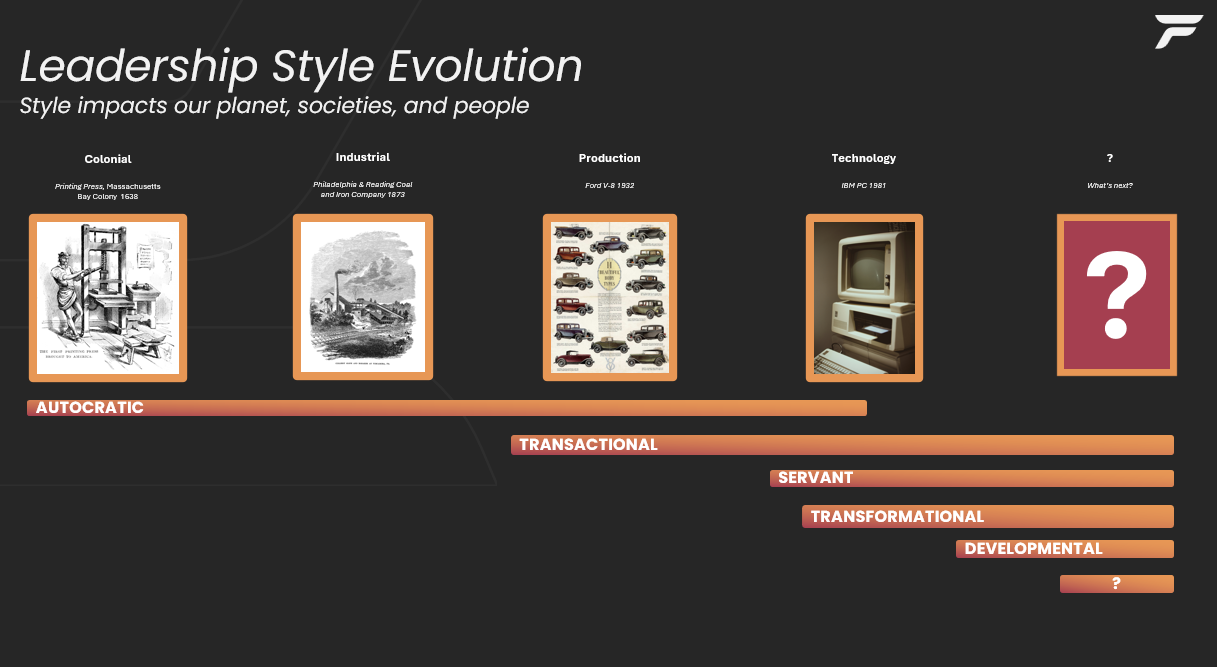
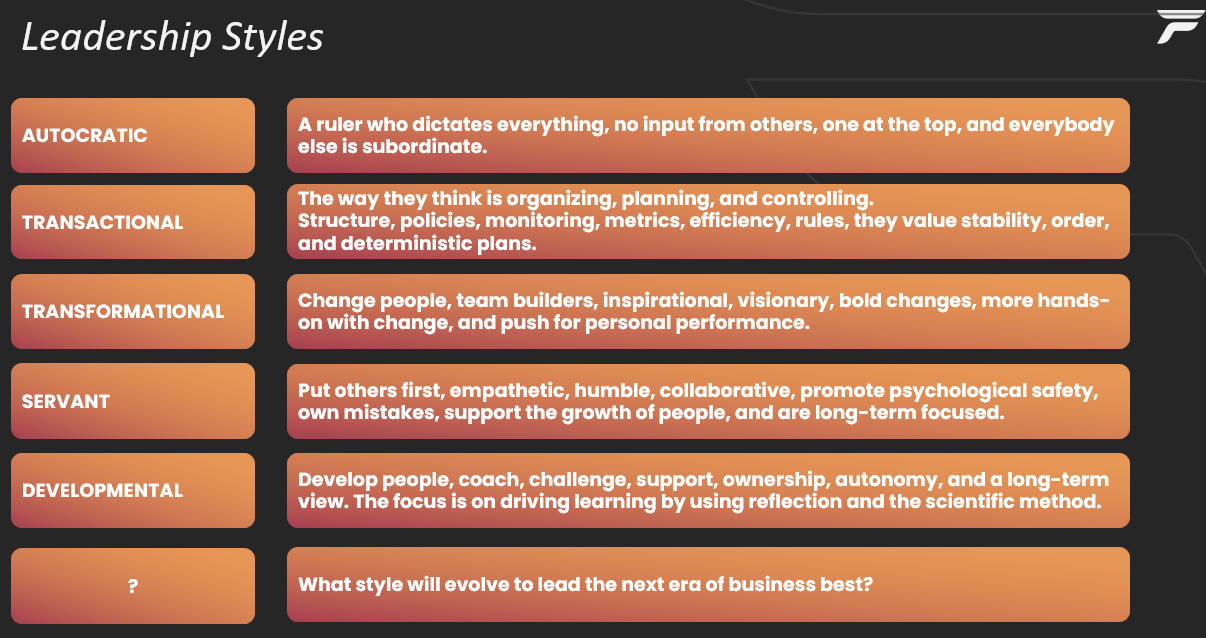
Leadership styles drive leaders' behavior. It is good for us to reflect on our style and evaluate whether it aligns with the market and the system of work we are in. It is also important to reflect on our leadership history and get a better sense of what our future will look like. This will help us dial in our style for what is coming, and we might need skills in some areas we don't have today to be more effective.
Below are a couple of slides from my Introduction to Leadership material that help explain leadership styles.
More on Workflows from our Resource page
- How to develop workflow maps. How to design business operational workflows.
Workflow Mapping Basics
-
Workflow Overview and Background
-
How to build a workflow map
-
How to improve a workflow
-
How to get started
Workflow Facilitator Guide
Learn how to facilitate the development and improvement of a workflow.
-
How to get started: Problem Statement and Expected Outcome
-
How to work with teams and leaders: Who, When, and Why
- How to improve a workflow
- Pre-session
- Develop a High Level Schedule
- Initial Kick-off session
- Current State Assessment
- Discovery Analysis
- Future State Plans
- Flow walk / Report out
- Follow-up