
Sound Familiar?
Work feels harder than it should. You're growing, but progress is slowing. You've hit a wall, but hiring isn't fixing it. You add headcount, but execution isn't improving. You can't add people to help keep up. Somehow, it takes heroic efforts to get normal things done. Difficult to grow because everyone is already overloaded.
The Current Environment
Today’s world makes it extremely difficult for leaders to grow a business. We all know that most businesses fail after they start out, and over time, most are gone. There aren’t many businesses left from the Industrial Age. In business today, complexity is increasing, change is accelerating, and competition is relentless. Scaling a business, then, is not a rosy picture in this context. The odds are not in your favor as a leader. With that said, there are steps you can take to scale and overcome these challenges, so let's dig in.
Leadership Style Matters
Leadership style can affect the ability to scale. Developmental leaders will be the leaders of the future. Transactional leaders' businesses will suffer the same fate as Industrial Age businesses in time, even though they still dominate leadership positions today. Many leaders are unaware that they are using the transactional leader’s playbook because that leadership style has dominated leadership thinking for the last 100 years.
Transactional leaders think in this way: organizing, planning, and controlling. They like structure, policies, monitoring, metrics, efficiency, and rules; they value stability, order, and deterministic plans. They lead from the top of the organizational hierarchy and tend to manage by results. This type of leadership goes like this: vision, strategy, goals, manage by walking away, then carrot and stick. They are short-term, focused on quarterly revenue, and are likely corporations with a primary focus on shareholder value. Leaders using this playbook will find it difficult to scale.
On the other hand, leading with a developmental style is gaining traction, and today's environment is driving this shift. Developmental leaders focus on developing people; they coach, challenge, and support, promote ownership and autonomy, and take a longer-term view. They drive learning through reflection and the scientific method. Developmental leaders focus on winning the war, not the current battle. They are more likely to be involved with their teams as they work, and many will see the value in Management by Means, in other words, they believe the best way to get results is to focus on how their teams work. They roll up their sleeves and are in it with their teams, not leading from above.
The foundation for sustaining a business is the same as scaling one. A company's ability to overcome complexity, adapt to change, and fend off the competition depends on its people knowing more than its competitors. Ignorance isn't a good strategy and focusing on efficiency stifles learning. The idea of efficiency itself is fine; it is our implementation of it that leads to problems. Knowing more and learning faster is the key to success, sustainability, and scale. This is the development style leader’s wheelhouse. Figure 1 shows the evolution of leadership style. Keep in mind that no leader has a single style, but they do have a dominant one, as shown below. For more on leadership style and trends, see this slide deck: Introduction to Leadership.
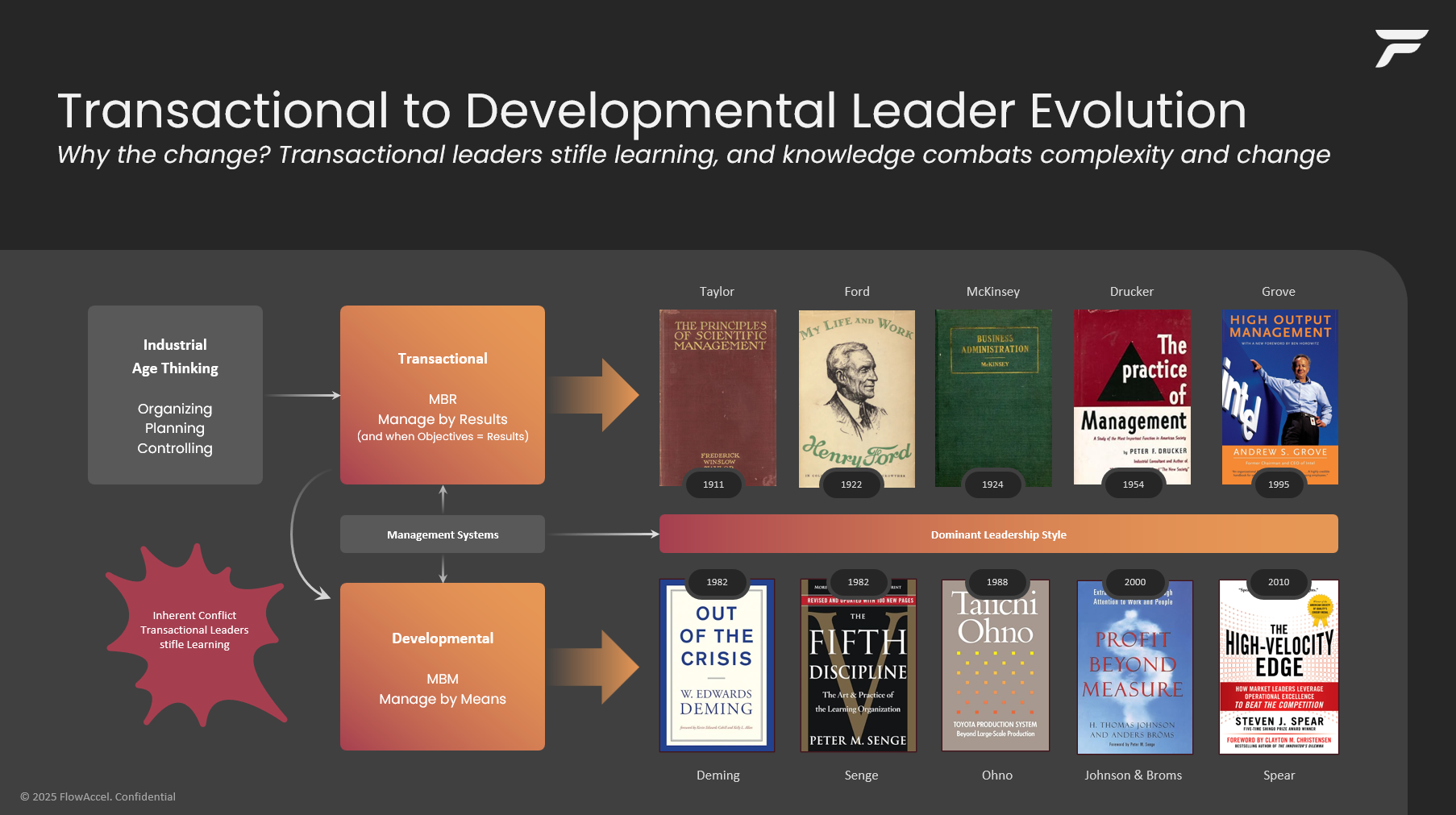
Figure 1
If you want to scale, use the Developmental Leaders Playbook.
Complexity and Change Limit Scale
An understanding of complex systems is key if you want to scale. Markets and businesses reside within a complex system. These systems bring about complexity and change. They are neither deterministic nor controllable; the planning horizon grows shorter as the years go by, and opportunities and problems emerge without notice. This is what they do; complex systems are the opposite of static.
The only way to navigate increasing complexity and accelerating change is to learn from within the system. Complex systems behave like natural systems. The farther out the forecast, the less accurate the prediction. This is how we understand the weather: sample, forecast, measure, and repeat. This mirrors the scientific method: problem statement, hypothesis, then test. The hypothesis is then confirmed, indicating the outcome was known, or refuted, creating an opportunity to learn why the prediction didn’t come true. Leaders need to drive learning. Model more, experiment more, and document what is known so that everybody can utilize it as they work. Learning and knowledge are required to scale. More on complex systems in the same deck: Introduction to Leadership.
Scaling Operations is Key
Not only is the environment becoming complex and changing, but so is how we do work. Creating and delivering value to the customer is harder with each cycle and each year. The transistor was invented in 1947, and today there are billions of them in semiconductor devices. Leading the design of a transistor radio was much less complicated than leading the design of a processor with AI capabilities today. A transistor radio would take a few dozen engineers a year or two to design, implement, and test. A leading-edge processor can take 5 years of work by thousands of engineers. Planning, coordinating, and orchestrating work for a transistor radio is very different from that for a leading-edge processor today. This additional complexity of work limits growth and often makes just keeping up a huge challenge. This is why leaders need to pay more attention to work than they have in the past. If you want to scale, leaders have to lead how their teams work to overcome complexity and change.
To get started on scaling, draft a problem statement and expected outcome. For example, our development time is too long at 18 months, and we can only develop two products at a time. This is keeping us from gaining market share and limiting scale because our competitors enter the market before we are ready to ship our new products, and they have more products to offer. To scale the business, we need to be able to develop 3 products in parallel with a one-year duration from concept to delivery. This problem and outcome need more work, but they are acceptable as examples of what to do. Now, leaders need to get ready for their homework.
First, to scale, there needs to be a deep understanding of the current state of the work operations before any decisions are made about how to move forward. I would visualize that work as a process map with the people who do it. If you don't do this first, initiatives are unlikely to achieve the desired results because the work on the ground must deliver scale. Leaders, tools, and consultants don’t deliver scale; the business operations do. The company's workflows are designed to deliver what you deliver today. To scale, things have to change in some way, so what to change and in what order has to be clarified.
Don't throw people or money at the problem just to get started; sometimes that only makes things worse. The initial reaction is to look to tools like a new ERP system or AI, but there are no quick fixes or silver bullets for scale challenges, even though you may very well need both ERP and AI. Also, if it were easy, leaders would have already done it. Knowing what to do and in what order takes homework; there are no shortcuts, no matter what anyone tells you. You must develop your own plans for scale because no one has the same ingredients you do or arranges them the way you do now. Don’t buy into someone's opinion on what to do, because they don't understand the details of your business either. Even if you want to hire someone to help, do this first; then you can better fit their recipe to your ingredients.
Next, identify which activities within operations are limiting scale. No solutions yet; still learning. Be patient. Opportunities to scale operations usually lie in work that crosses teams, a lack of resources or tools, overly complicated flows or products, overly aggressive plans, resources allocated across programs, knowledge gaps, and so on. There are an infinite number of possible scale limiters, and everyone will have a unique set, even though some will be common across organizations. Once leaders have a deep understanding of the current state of business operations and some idea of the limiters, it's time to design the process the company needs. The new design needs to be informed by the current design, don't just jump straight there. A disconnected future state design can take an infinite amount of time to achieve. Now design a process to deliver three programs that run in parallel, each with a year-long development period. This was the expected outcome. This will be your blueprint for scale, and the current state will enable a gap assessment to inform scaling activities and priorities. Also, the blueprint may change over time; be open to change as teams learn. This is where the use of tools and AI will emerge; don’t predict up front when you know the least about what is limiting scale. Knowing the order of changes can be as important as knowing what to change. Lastly, there is no way to jump directly to a future state; the only way is from the current state. Unless you are willing to stop work completely, redesign, and then start again. It is much better to learn your way there, not guess at the future state you need and take all that risk.
Finally, leaders can begin to make changes. Keep in mind that this will take longer than you want, but it will get you to the finish line sooner than skipping the homework. Most importantly, leaders now have a clear understanding of the current state and a vision for the future state, so they are in a much better position to help their team get there. If done right, all leaders are on the same page. This will accelerate change and support scaling the business.
In summary, the current environment of complexity and change makes it difficult to scale. The best way to navigate these factors is to learn your way through them. Leaders with a developmental style are best positioned to make that happen. Leaders need to clearly define the challenges to scale and the outcomes they are seeking. After that, there needs to be a deep understanding of how work is done today, including its evident limitations, and then design the future-state operations you need. Once that is in place, conduct a deep-dive gap analysis to create a list of the work needed to achieve the desired scale outcome. Now it's time for change and program management to make it happen. Remember, there are no shortcuts; it will take longer than you want, but you and your teams will be on the same page as you create the change you need.
We help semiconductor companies go faster and scale with the team they have