
I was in a new role as a Fab Product Engineer at a semiconductor factory. I was learning the role and getting some practice. Then one day, my manager said there was a new program and that I would be the New Product Introduction (NPI) Chair for that program. I thought, great! Then he told me that the factory manager had committed to a 25-day lead lot throughput time. I thought, okay. Then he said the best we had done to date was 35 days. I thought, oh crap. As he was walking out of the room, he said this would be over the Christmas holiday. I then thought, I am in trouble.
A lot consists of silicon wafers processed in a semiconductor factory. A lead lot is the first lot processed and then sent back to the development teams for testing. Product development can take anywhere from a year to many years, depending on the device's complexity and purpose. Delivering processed silicon wafers back to the product development teams is a key milestone in the development of semiconductor devices and products. A factory lead lot is also called first silicon. Up to this point, development teams have mostly used models, maybe some FPGA prototyping, and test chips to verify or validate the product's functionality and performance. First silicon is the real deal, and everybody is on edge to see if the device will function as the models predicted.
As the NPI Chair, I had been running meetings for 6 months to set up our factory so we would be ready to manufacture the new device when the design was complete and the reticles were made. Different semiconductor devices have different topologies, layers of silicon, implants, oxides, and metals, as well as different dimensions, and so on. Each one, even though similar, can be very different at the molecular level. The teams in my meetings came from lithography, etch, process integration, metrology, manufacturing, and other functional teams. We had been making progress, but I could tell nobody wanted to be there because they were all trying to qualify their tools for the current product, and I was talking to them about the next product. They were under the gun, and everybody was a bit stressed trying to get their work done, so that our device wouldn’t slow down the larger platform's delivery schedule. Nobody in product development wants to be in the critical path to launching a new product; it is not a comfortable position. I thought this wasn’t going fast enough, and we wouldn't be ready in time. It was playing out as I feared.
Then our manufacturing manager introduced me to a new Lean coach who could help me with my dilemma. Lean production was new at the time, a few years after MIT and Womack discovered The Toyota Production System. I thought, great, some help. The coach said we were going to run a Kaizen. I said ok, but had no idea what that meant. The coach spoke to the team and their leadership and got them to commit to a two-day Kaizen. I thought, how in the world did she get two whole days from these people? The only way that would have happened was if the factory manager had approved it and his staff had been aligned with this priority. Remember, everybody’s hair was already on fire from the current product barreling down on them. I brought the Lean coach into our meeting, and we worked on who should attend the Kaizen. We drafted a problem statement and expected outcome, and nailed down other details before the event so we would be ready.
This experience was life changing and career changing. In two days, using a long whiteboard on a meeting room wall and colored sticky notes, the team created a 25-day flow for our lead lot. I was completely shocked. By visualizing the work, we got more done in two days than I had in 6 months. I still get goosebumps recalling that day. Weeks later, with a principal engineer shepherding the lot in the factory, we delivered the lead lot in 22 days. That was a 37% reduction in cycle time compared to our best ever. A year later, every lead lot was 25 days, and we ran them with ease; it was business as usual.
What I saw happen. First, we put a problem to solve in front of a bunch of engineers. That is like waving a fish you just caught in front of a jaguar. They worked on that problem for 2 days. They mapped out our 35-day flow and then incrementally improved it. They wrote code, modified and tested tools, created checklists, and did 50 other things. In true Kaizen form, we did most of that work in those two days; it wasn't just coming up with a plan. The coolest part was that mapping out the flow on the whiteboard completely disarmed the conflicts that plagued our meetings. They worked together and enjoyed the experience. It was a great accomplishment, and they felt good about it.
Over the last 20 years, I have been involved in developing many workflow maps. I have developed maps for design teams, software developers, supply chain, architecture, technology development, marketing, finance, debug teams, and more. We utilized them to build our customer engineering team for our growing business. Any leader can use this method; the type of work doesn’t matter. You just need some work that people do, a problem, and an outcome you are looking for. Mapping out the roles, responsibilities, and sequence of activities that teams perform in their daily work can yield significant rewards for leaders and companies.
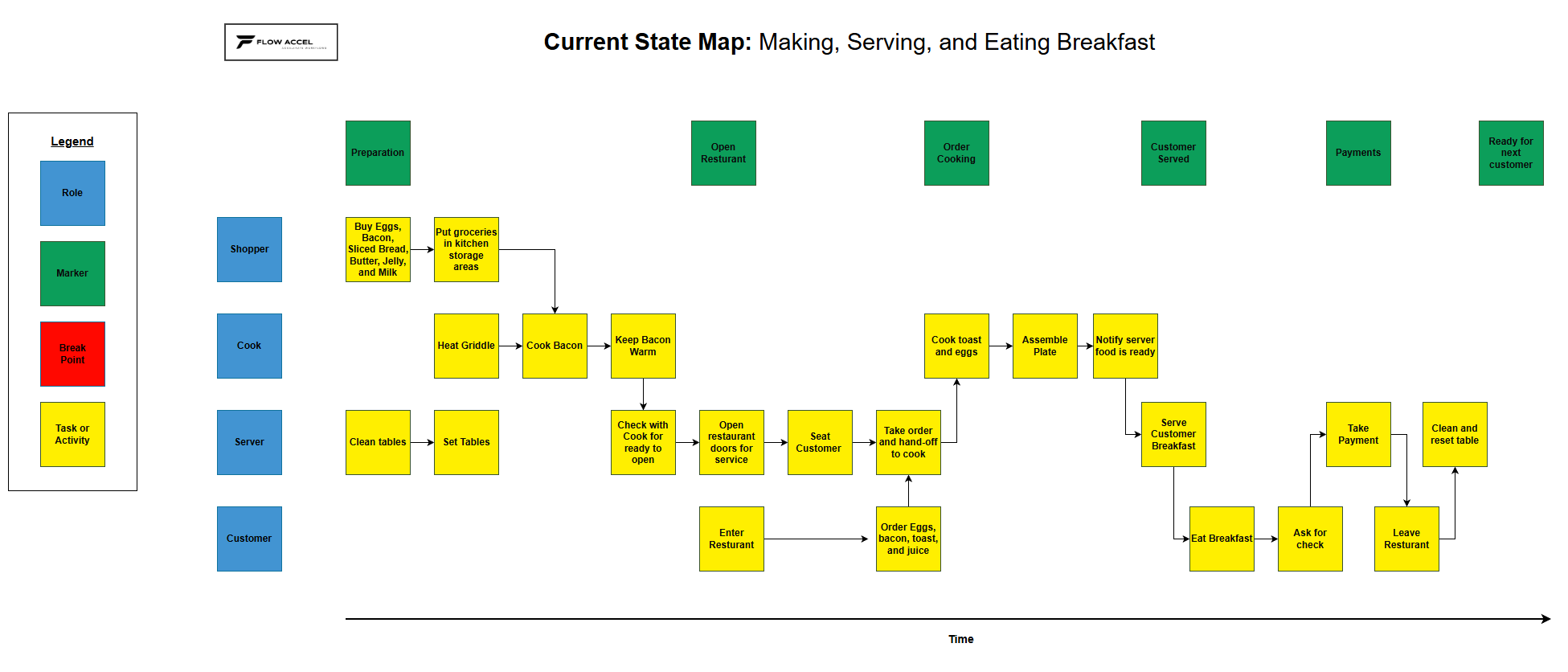
Over time, things change, and our workflows evolve because of issues here and there. Then meetings are created to solve other problems. If leaders don’t pay attention to how teams work, velocity slows, and more problems emerge. Leaders are constantly surprised by the causes of problems discovered in workflow mapping; they are usually not what they thought. Leaders tend to see the symptoms, not the root cause. Not only that, but visualizing work is a great way to get leaders aligned on how teams work and the problems they face. We all see problems from our perspective, which is never a complete picture of how things are. Aligning leaders on cross-team work is key to making work go faster. If you want to be a leader who can help their teams do more work with less effort, go faster, and scale their ability to do work at the same time, learn how to develop a workflow map. You can start here, and there is more information on my resources webpage.
We help semiconductor companies go faster and scale with the team they have